

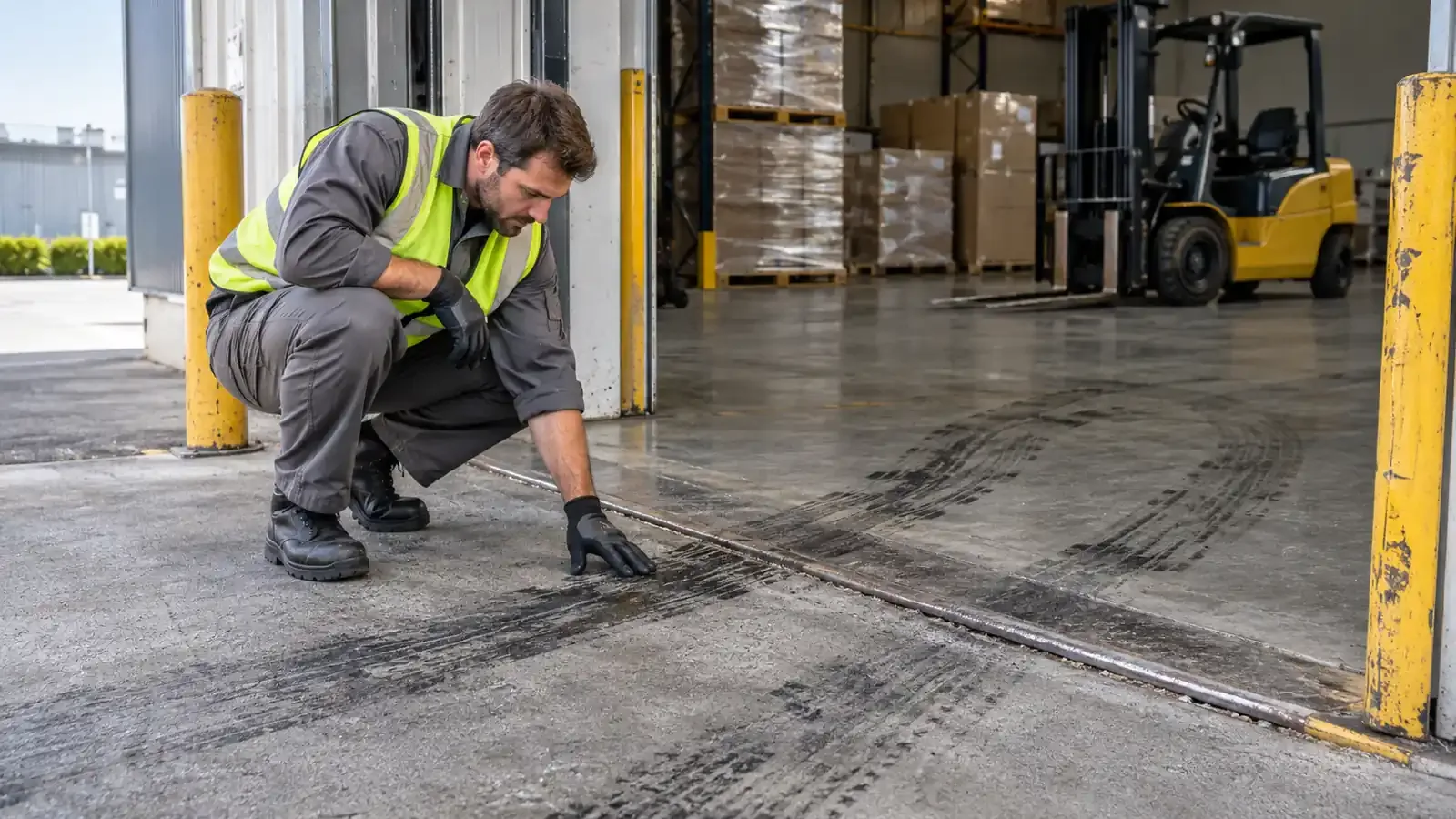
Grease marks inside a warehouse can look like an indoor floor-care problem. Yet if the same dark tracks return after scrubbing, the floor may only be the last stop in a longer contamination route. Forklift tires, pallet-jack wheels, cart casters, and work shoes can pick up residue at the loading dock and carry it across the threshold.
Effective loading dock cleaning has to interrupt that route. The goal is not simply to make one concrete slab look better. It is to remove transferable grease at its source, clean the surfaces carrying it, manage the washwater, and confirm that normal traffic no longer brings the mess back inside.
Read the Grease Marks as a Route, Not a Collection of Spots
The shape and location of the marks can help narrow the scope before cleaning begins. Repeated tire-width lines from one bay, dark turns near a dock plate, or footprints that fade farther into the building can show how residue is moving.
Treat the problem as three connected zones:
| Zone | What to inspect | Why it matters |
| Source zone | Apron, bay, dock plate or leveler area, equipment parking points, leaks, and spill locations | This is where fresh grease enters the route. |
| Transfer zone | Tires, casters, footwear, mats, seams, ramps, and the threshold | These surfaces carry residue from outside to inside. |
| Receiving zone | The first indoor aisle, staging area, and recurring track pattern | This shows how far the grease has traveled. |
Cleaning only the receiving zone resets the appearance without breaking the route. Cleaning only the darkest outdoor stain can also fail if the wheels, threshold, or active leak remain contaminated.
A Source-Focused Cleaning Scope Follows the Contamination Path
The work should move in a deliberate sequence so freshly cleaned areas are not immediately re-soiled. The exact products, temperature, pressure, and recovery method depend on the surface, residue, drains, and facility requirements.
Stop Fresh Grease From Entering the Route
An active hydraulic leak, damaged container, dripping compactor, or repeated spill is an operations or maintenance issue first. Deep cleaning cannot outpace a source that continues releasing grease. Restrict traffic through a fresh spill, use the facility’s spill-response procedure, and correct the source before treating the wider track pattern.
This is also a safety decision. OSHA’s powered industrial truck guidance warns that driving over oil or grease can enlarge the hazardous area and says the spill should be cleaned before proceeding.
Recover Loose Material Before Pressure Washing
Dry debris and free grease should be removed before water is introduced. Absorbent material, sweeping, scraping, or another facility-approved recovery method can reduce the amount of contamination that becomes washwater. This is not optional housekeeping around the main job. It changes what the cleaning process must contain and dispose of.
Match Degreasing and Washing to the Surface
Grease-contaminated concrete needs a different approach from ordinary dust or mud. Industrial degreasing services may pair appropriate cleaning chemistry with hot-water pressure washing to loosen oily residue, followed by controlled rinsing and recovery. Manufacturer guidance on heated pressure washing explains that heat can help break up lubricant residue, but it does not replace the correct cleaner, safe handling, suitable pressure, or enough contact time for the selected product.
For a related example of how grease changes the cleaning plan for exterior concrete, see our dumpster pad cleaning service.
Commercial concrete cleaning also requires realistic expectations. The American Cement Association’s stain guidance notes that treatment should match the stain and that dry removal methods may be needed after a substance has soaked in.
An old shadow can therefore remain after transferable surface residue has been removed. Coatings, repaired concrete, joints, dock equipment, and adjacent materials may require lower pressure or a separate method. A test area helps set the scope without promising complete stain removal.
Control Washwater Before the First Rinse
Greasy washwater should not be treated like rainwater. The Maryland Department of the Environment’s pavement and building washdown guidance places conditions on pavement washwater and identifies dry cleanup, pollutant controls, capture, and permitted disposal routes as important considerations when oil, grease, or cleaning chemicals are involved.
That means the drainage plan belongs in the scope before washing starts. The team needs to identify nearby drains, determine where they lead, contain the work area as appropriate, and use a disposal route authorized for the actual wastewater. A cleaner being labeled biodegradable does not by itself make greasy washwater suitable for a storm drain.
Clean the Transition and Indoor Trail Last
Once the source zone is clean, address the threshold, mats, wheel contact points where the facility’s procedures allow, and the indoor trail.
Then keep traffic out until the route is clean and dry enough to reopen. OSHA’s walking-working surfaces standard requires workplaces to maintain walking surfaces in a clean, orderly, and, as far as feasible, dry condition and to correct or guard hazardous conditions before use.
Judge Success After Normal Dock Traffic Resumes
A clean appearance immediately after service is only the first check. The stronger test is whether grease tracks reappear after the dock returns to normal use.
If marks return quickly, investigate the pattern rather than ordering another full round of warehouse pressure washing. A fast return can point to:
- an unresolved leak or spill source;
- grease left in a seam, threshold, mat, or wheel path;
- contaminated equipment traveling between zones;
- a cleaning interval that does not match traffic and soil load; or
- a scope that ended at the dock door instead of following the full route.
Cleaning frequency should follow how quickly transferable residue returns, not a generic monthly or quarterly rule. A high-traffic bay with frequent oily deliveries may need attention sooner than a lightly used dock. Track the source, service date, affected bay, indoor return time, and any equipment leak so the schedule responds to evidence from the facility.
The Best Scope Stops the Loop Instead of Moving the Mess
When grease keeps appearing indoors, the warehouse floor is often reporting a problem that began elsewhere. The practical response is to trace the marks back to the active source, treat the dock and transfer zone as one connected system, control the washwater, and clean the indoor trail only after the source route is broken.
That approach gives loading dock cleaning a measurable outcome: not just brighter concrete on service day, but less grease crossing the threshold after ordinary traffic starts again.
Frequently Asked Questions
Why does grease return after the warehouse floor is scrubbed?
Indoor scrubbing removes the receiving-zone residue, but it may leave the dock, threshold, tires, casters, or mats contaminated. Normal traffic then carries grease back across the same route. Trace the returning marks to the bay and equipment path before repeating the indoor clean.
Is hot water always required for loading dock cleaning?
No single method fits every dock. Hot water is often useful for oily or greasy residue, but the right approach also depends on the type of grease, surface condition, coating, cleaning product, drainage, and recovery plan. More heat or pressure is not automatically better.
Can old grease stains be completely removed from concrete?
Not always. Cleaning may remove the transferable film while leaving discoloration that has penetrated porous concrete. A test area can help distinguish removable residue from an older embedded shadow and set realistic expectations before the full job.
How often should a loading dock be professionally cleaned?
Base the interval on traffic, spill frequency, residue type, weather exposure, and how quickly marks return indoors. Record the time between cleaning and visible re-tracking. That return time is more useful than choosing a universal monthly, quarterly, or semiannual schedule.
Can cleaning take place while the warehouse is operating?
Often it can be scheduled around operations, but the work zone needs controlled access. The plan should account for truck arrivals, forklift routes, pedestrian traffic, drainage, cleaning-product contact time, washwater recovery, and drying before the area reopens.
What should happen to greasy loading dock washwater?
The disposal path depends on the contaminants, products used, drainage connections, and local requirements. The scope should identify drains before work, keep polluted water out of unauthorized stormwater routes, and provide for collection, treatment, sanitary discharge with appropriate authorization, or off-site disposal as applicable.
Can pressure washing damage loading dock concrete or coatings?
Yes, unsuitable pressure, heat, chemicals, or technique can affect weakened concrete, joints, sealers, coatings, and adjacent materials. The surface condition and manufacturer instructions should guide the method, with a test area used when compatibility or expected results are uncertain.
Does deep loading dock cleaning replace spill response?
No. A fresh leak or spill needs immediate control under the facility’s spill-response procedure. Scheduled cleaning addresses the wider residue and transfer path after the active source is stopped; it should not be used to wash an uncontrolled spill toward a drain.
