


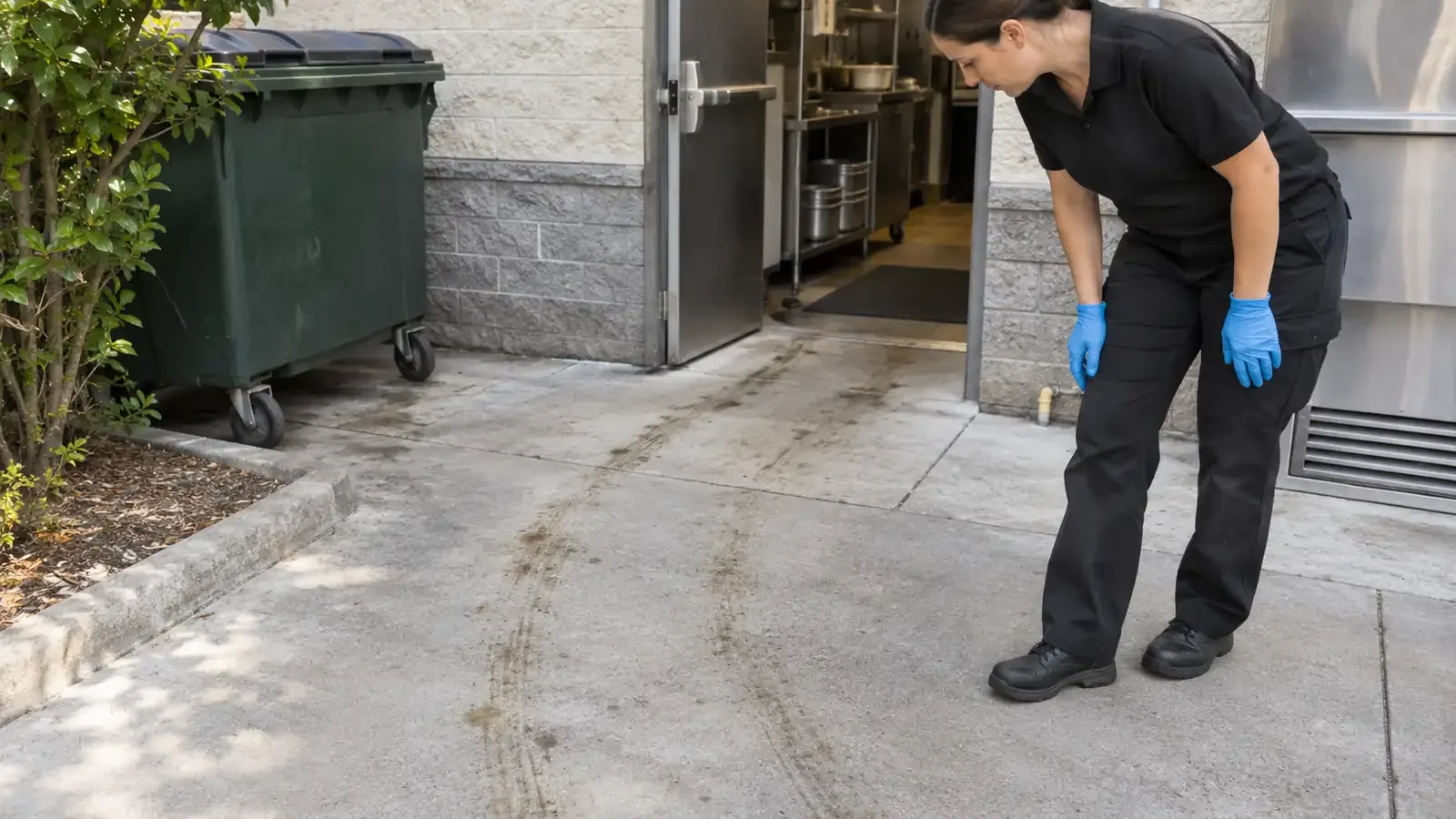
A freshly cleaned entrance can start showing dark, sticky footprints again within days. When that happens, the entrance may not be where the problem begins. It may simply be the last visible stop on a longer grease route.
Cooking oil, vehicle fluids, leaking waste bags, and greasy service areas can contaminate shoes, cart wheels, and tires. Each trip may carry a small amount toward the customer entrance. Cleaning only the most visible concrete resets the final section of that route while leaving the source and connecting surfaces untouched.
Effective commercial concrete cleaning should follow the buildup backward. The scope needs to identify where grease begins, how it travels, and which connected surfaces must be cleaned or better controlled to slow its return.
The Entrance Is Evidence, Not the Whole Cleaning Boundary
The pattern around the doorway can reveal how contamination is reaching it. The goal is not to assume every dark mark is grease, but to compare the entrance with the routes used by employees, deliveries, waste carts, and vehicles.
| Possible starting point | Common transfer route | Clues to inspect |
| Rear kitchen or service door | Employee footwear and carts | Repeating footprints or wheel marks leading away from the door |
| Dumpster or used-oil area | Leaking bags, cart wheels, and foot traffic | Dark buildup along the waste route and around turns |
| Loading or delivery area | Dollies, pallet jacks, and vehicle traffic | Parallel wheel marks or staining near receiving doors |
| Drive-through or service lane | Tires and employees crossing the lane | Concentrated buildup near windows, curbs, and pedestrian crossings |
The UK Health and Safety Executive recommends identifying where floor contamination originates, including spills, runoff, and footwear, before choosing controls. That same source-first contamination principle is useful when exterior grease keeps reappearing at an entrance.
Map the Grease Route Before Setting the Scope
A site walk should follow the property in the direction the grease travels, not merely follow the cleanest path for the equipment. Start at the suspected source and continue through every surface that regularly connects it to the entrance.
A useful route review should answer four questions:
- Where is grease first reaching the ground?
- What shoes, wheels, tires, or leaking materials can pick it up?
- Which doors, walkways, turns, ramps, or curb cuts form the travel route?
- Where does the buildup become visible, sticky, or repeatedly difficult to maintain?
Check the route in both directions. A dark trail leading from a waste enclosure may support one explanation, while isolated staining beside the front door may point to spilled food, vehicle drips, or another local source. Appearance alone does not confirm the cause.
Why Entrance-Only Cleaning Fails
Cleaning the entrance can improve the property immediately, but that improvement may be short-lived when the rest of the transfer chain remains active.
Transfer Continues During the Next Shift
An employee, waste cart, or delivery wheel that crosses greasy concrete can carry residue onto the newly cleaned route. The entrance becomes dirty again even though the original cleaning was effective.
Mats can help remove contaminants from footwear, but they must be correctly placed, large enough, and maintained. NIOSH guidance on entrance mats also notes that worn, curled, or poorly secured mats can create problems of their own. A mat is a supporting control, not a substitute for cleaning the grease source.
The Darkest Mark May Not Be the Source
Traffic repeatedly presses residue into entrance concrete, so the most visible stain may appear far from the heaviest original deposit. Older oil or grease can also soak below the surface and leave discoloration after the removable buildup is gone.
The American Cement Association’s concrete-care guidance explains that stain treatment should match the type and depth of the contamination. This is why a cleaning proposal should distinguish between removing active residue and promising that every old shadow will disappear.
One Frequency May Not Fit the Entire Route
The dumpster pad, back door, drive-through window, and front entrance may accumulate grease at different rates. Putting every area on one schedule can leave the source under-cleaned or cause customer-facing concrete to receive work before it needs it.
The first cleaning should establish a baseline. Later inspections can then show which zone becomes contaminated first and which areas can remain on a longer interval.
Build a Three-Layer Concrete Cleaning Plan
A practical scope divides the property into three connected layers. Each layer has a different role in stopping repeat tracking.
Layer One: Control the Source Zone
Start with the surface where grease is spilled, leaked, or deposited. This may include the back door, used-oil area, dumpster enclosure, loading dock, drive-through window, or service bay.
The plan should also address the operational reason grease reaches the concrete. Exterior cleaning cannot repair a leaking container, change an indoor floor-maintenance process, or service equipment outside the contract. Those problems need to be assigned separately or the cleaned surface may be contaminated again.
When waste-area concrete is the starting point, our dumpster pad cleaning service provides the adjacent service context for that source zone.
Layer Two: Clean the Transfer Route
The connecting path may include rear walks, delivery lanes, curbs, ramps, employee entrances, and sections crossed by carts or vehicles. Cleaning isolated spots can leave enough residue between them to restart the trail.
The route scope should state which surfaces, edges, joints, and turns are included. It should also identify when carts, dumpsters, vehicles, or other obstructions must move so the actual travel path is accessible.
Maryland’s pavement washwater guidance treats oil, grease, detergents, and mobilized solids as factors that change how washwater must be managed. Drain locations and the approved water route therefore belong in the plan before wet cleaning begins.
Layer Three: Restore the Customer Entrance
The entrance apron, doorway approach, and adjacent sidewalk are the final layer. This section should be cleaned after the upstream route is addressed so traffic does not immediately carry residue back across it.
For employee walking-working surfaces, OSHA requires clean and, where feasible, dry conditions, along with correction or guarding of hazardous conditions. Cleaning should therefore be scheduled around access, with the active area separated and reopened only when appropriate.
Our storefront cleaning service can place entrance-apron cleaning within a broader customer-facing exterior scope when those surfaces need coordinated attention.
Let the Return Pattern Set the Maintenance Plan
After the first full-route cleaning, record where grease appears first, how far it travels, and how quickly the entrance changes. That return pattern provides better scheduling information than a generic monthly or quarterly rule.
If grease returns first at the source but the route remains clean, the source zone may need more frequent attention. If footprints reappear along the entire path, the transfer route or an operational control may be incomplete. If only the entrance changes, investigate local spills, customer traffic, nearby parking, and drainage before assuming grease traveled from the back of the property.
The maintenance plan should change when the evidence changes. Repeating the same entrance cleaning without checking the route may improve appearances for a short time, but it does not explain why the buildup keeps coming back.
A Clean Entrance Should Be the Final Link
When grease repeatedly tracks through an entrance, the most useful question is not simply, “How do we clean this spot again?” It is, “What keeps carrying grease here?”
Commercial concrete cleaning becomes more effective when the scope connects the source zone, transfer route, and entrance. Clean the active buildup, address the surfaces that transport it, and watch where it returns first. The entrance can then remain the final clean link in the route instead of becoming the property’s recurring trouble spot.
Frequently Asked Questions
How can I tell whether grease is being tracked to the entrance?
Look for repeating shoeprints, wheel marks, or darkening along a continuous route from a service area, waste enclosure, loading zone, or drive-through. These clues support an investigation, but they do not prove the source without a site walk.
Is pressure washing alone enough to remove grease from concrete?
Not always. The appropriate process depends on the surface, the type of residue, how long it has remained, and whether it has soaked into the concrete. A general rinse may move loose dirt while leaving oily residue or deep discoloration behind.
Should the grease source and entrance be cleaned during the same visit?
Often, yes. Coordinating the connected zones reduces the chance that traffic will carry residue from an untreated source onto newly cleaned concrete. Access, drainage, operating hours, and surface conditions still need to be considered.
How often should grease-prone commercial concrete be cleaned?
There is no reliable universal interval. Start with the rate at which each zone becomes contaminated. A waste or drive-through area may need more frequent service than the connecting walkway or front entrance.
Can entrance mats stop grease tracking?
Mats can reduce some transfer from footwear when they are correctly selected, positioned, cleaned, and replaced. They cannot stop leaking waste, dirty cart wheels, contaminated exterior routes, or grease already embedded in the concrete.
Can grease-contaminated washwater enter a storm drain?
Do not assume it can. The contaminant, cleaning products, drain destination, local requirements, and available collection options all affect the proper route. In Maryland, oil and grease materially change the conditions described for pavement washwater.
Will commercial concrete cleaning remove every old grease stain?
No result should be promised without examining the surface. Removable residue may come away while an older stain leaves a shadow below the surface. A proposal should separate cleaning expectations from coating, resurfacing, or concrete replacement decisions.
