

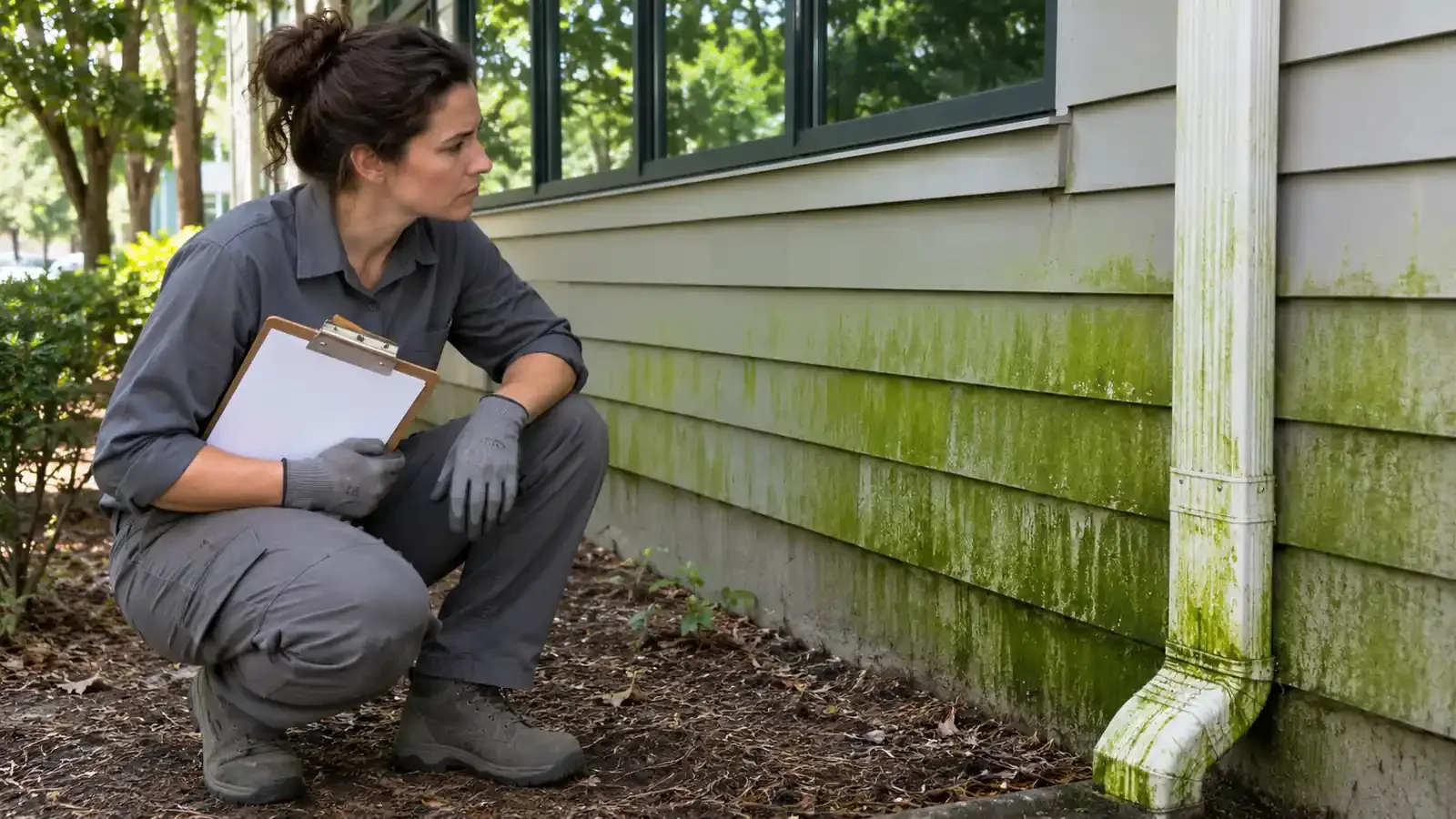
When one side of a commercial building repeatedly turns green while the other elevations remain relatively clean, the difference is rarely random. That wall may receive less sunlight, dry more slowly, sit beneath trees, or collect water from a roof edge, downspout, irrigation system, or mechanical equipment.
Commercial building pressure washing should respond to that pattern. Cleaning can remove surface growth, but it cannot correct a leak, drainage defect, or wall assembly that stays wet. A useful scope therefore considers each elevation separately instead of assuming every side needs the same treatment and schedule.
The Green Side Is Showing You How That Elevation Dries
A building has several small exterior environments rather than one uniform condition. Sun exposure, wind-driven rain, nearby vegetation, surface texture, and architectural details can change how long moisture remains on each wall.
Research on algae and cyanobacteria colonization identifies precipitation, humidity, nearby vegetation, facade coatings, and architecture-created dampness as interacting influences. This helps explain why the shaded wall may regreen long before a sunny entrance elevation.
That pattern does not necessarily indicate a building defect. A shaded wall may receive less sunlight and airflow, causing moisture to linger and the surface to dry more slowly. However, growth concentrated beneath one drain, sill, joint, or piece of mechanical equipment deserves closer attention.
The National Park Service’s masonry-cleaning guidance makes the practical point that biological growth associated with moisture and limited sunlight will continue to recur unless the contributing conditions change. Cleaning is still useful, but it should not be mistaken for moisture correction.
Read the Green Pattern Before Scheduling the Wash
The location and shape of the discoloration can help a property manager decide whether the project is routine cleaning or cleaning combined with further inspection. These signs can point to a cause, but they do not confirm what is happening inside the wall.
A Broad Film Across Most of One Elevation
An even green cast on a shaded side often points toward slower drying across the entire surface. Tree cover, an adjacent building, deep overhangs, or the wall’s orientation may all contribute.
This pattern may support cleaning that elevation more frequently than the building’s sunnier sides.
Narrow Streaks Below Roof or Wall Details
Repeated streaks beneath a parapet, gutter, downspout, window sill, coping joint, or air-conditioning drain suggest a concentrated water path. The relevant component should be checked before the stain is treated as an ordinary cleaning problem.
The EPA’s building moisture guidance recommends inspecting exterior walls, drainage assemblies, flashings, roof overhangs, and penetrations as part of moisture control and maintenance.
A Green Band Near the Bottom of the Wall
Growth concentrated near grade may be connected to splashback, irrigation, poor surface drainage, dense landscaping, or debris that keeps the base of the wall damp. The surrounding ground and water sources belong in the site review.
Patches Around Cracks, Joints, or Panel Edges
Localized growth around failed sealant, open joints, damaged coatings, or loose facade components calls for a repair assessment. Washing should not be used to hide a condition that could allow water behind the exterior finish.
Scope Commercial Building Washing by Elevation
A useful commercial building washing proposal should describe more than total square footage. It should connect the visible condition to the material, exposure, and possible water source.
| Scope factor | Why it matters |
| Facade material and coating | Determines which cleaning products, pressure, and test procedures may be suitable |
| Shade and exposure | Helps explain uneven growth and different maintenance needs |
| Concentrated water paths | Identifies areas that may require drainage or repair work first |
| Growth severity | Affects treatment, dwell time, access, and rinsing needs |
| Previous cleaning history | Shows how quickly each elevation becomes visibly affected again |
| Occupants and site access | Shapes work zones, entrance access, vehicle movement, and scheduling |
The method cannot be selected from color alone. Manufacturer instructions may differ sharply between facade systems. For example, one James Hardie panel guide says not to use a water blaster, while a Swisspearl panel guide permits controlled pressure under specified conditions. The actual cladding and finish must govern the approach.
For office building exterior cleaning, the scope should also account for entrances, parked vehicles, occupied areas, landscaping, and any equipment needed to reach upper sections safely.
Cleaning Does Not Correct Trapped Moisture
The central decision is whether the wall is simply slow to dry or is receiving water from a correctable defect. Uniform regrowth points more toward exposure, while a narrow or worsening pattern can point toward a particular water path.
Consider a separate building-envelope or maintenance inspection when:
- The same narrow streak returns unusually quickly.
- Discoloration becomes more obvious after rain.
- A gutter, downspout, drain, or condensate line is overflowing.
- Sealant, mortar, coatings, or panel joints are visibly damaged.
- Interior staining or dampness appears near the affected exterior area.
- Water seems to remain behind or within a cladding system.
Building exterior cleaning services can address surface buildup. They should not be expected to repair flashing, drainage, sealant, cladding ventilation, or concealed water entry.
Use the First Wash as a Maintenance Baseline
Treat the first cleaning as a baseline, not a reset button. Dated photographs from the same locations can show which elevations remain clean and which begin changing first.
Record:
- The elevations and areas cleaned.
- The facade materials and finishes.
- Visible drainage or maintenance concerns.
- Before-and-after photographs.
- Repairs completed before or after washing.
- When discoloration first becomes noticeable again.
These records allow future work to follow the building’s actual condition. The sunny elevation should not set the maintenance clock for the shaded one. One side may need earlier inspection or targeted cleaning without automatically repeating a full-building project.
Ask Building Washing Services for a Condition-Based Scope
A clear request for building washing services should identify the green elevation, known facade materials, previous cleaning dates, access limits, and any history of leaks or drainage repairs. Ask how the proposed method will change across different materials and whether any areas should be repaired before washing.
If your property needs a site-specific assessment, our commercial building washing service provides a relevant next step. The goal should be a scope that cleans the surface while recognizing why one elevation is behaving differently.
Frequently Asked Questions
Is green discoloration always algae?
No. Green coloring can come from algae or another biological film, but appearance alone does not confirm the material. Paint changes, mineral deposits, dirt, and mixed growth can look similar from a distance. Surface identification and a test area may be needed before treatment.
Should only the green side of the building be washed?
Sometimes. A targeted elevation may be appropriate when the other sides remain clean, and the resulting appearance will be acceptable. A full-building wash may make more sense when other elevations also carry dirt, traffic film, or uneven weathering.
Will pressure washing keep the green growth from returning?
Cleaning removes existing buildup but does not eliminate shade, slow drying, leaking drainage components, or trapped moisture. If those conditions remain, the affected elevation may turn green again sooner than the rest of the building.
How often should a shaded commercial wall be cleaned?
There is no universal interval. Use inspection findings and the building’s documented regrowth history. A shaded elevation may need attention sooner than sunnier walls, while a repaired drainage defect could lengthen the interval.
Does the north-facing side always become green first?
No. Northern exposure can mean less direct sunlight in the Northern Hemisphere, but orientation is only one factor. Trees, neighboring buildings, prevailing rain, overhangs, irrigation, surface texture, and drainage details can make another elevation remain wet longer.
Should a leak or drainage problem be repaired before washing?
Usually, when a clear defect is present. Repairing an overflowing gutter, failed joint, or misdirected drain first can reduce immediate rewetting and prevent cleaning water from entering an already damaged area. The appropriate order depends on the wall system and repair scope.
Can the same pressure be used on every commercial facade?
No. Brick, painted masonry, stucco, fiber cement, coated metal, and other cladding systems have different limits. Manufacturer guidance, surface condition, coatings, joints, and test results should determine the method.
