


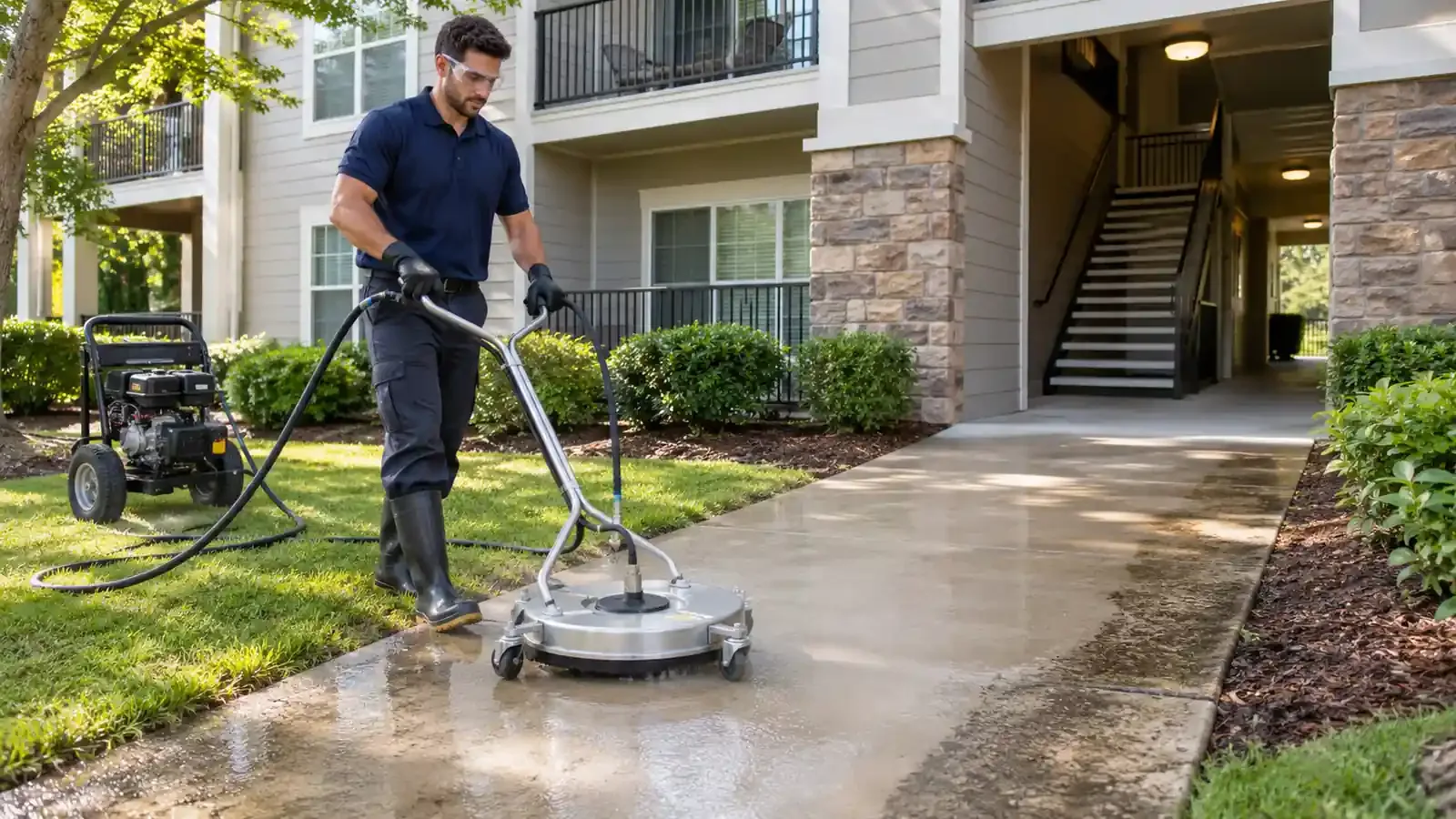
Repeated complaints about a dirty walkway or breezeway are rarely solved by washing only the square of concrete shown in a resident’s photo. That spot is where the problem became noticeable. The full cleaning zone may also include the stairs above it, the wall beside it, a leaking trash bag route, a damp edge, or the building entrance that hundreds of footsteps connect to it.
For property managers, the useful response is to inspect outward from each reported location. Prioritize the complete route residents use, identify what keeps adding soil or moisture, and separate cleanable buildup from repairs. That produces an apartment complex pressure washing scope that addresses the complaint instead of briefly changing its appearance.
Start With the Complaint Zone, Not Just the Reported Spot
A resident may describe “the breezeway” even when the visible problem is concentrated around one landing, doorway, or drain. Group reports by building, floor, route, and condition before setting priorities. Photos and dates can reveal whether several complaints point to one connected area.
During the site walk, expand each report in four directions:
- Follow the resident’s route from parking or the sidewalk to the unit door.
- Look above for drips, dirty stair undersides, cobwebs, or runoff marks.
- Check the edges for standing water, soil, leaf debris, and overflowing containers.
- Trace nearby operations such as trash pickup, landscaping, deliveries, and pet-waste stations.
This boundary check is the main difference between a lasting response and a spot treatment. If the complaint zone spans several surfaces or levels, the estimate should name those limits clearly.
Prioritize Complete Approaches to Building Entrances
Main walks, curb transitions, ramps, steps, landings, and the first section inside a covered entrance form one resident-facing route. Cleaning isolated rectangles can leave a visibly unfinished path and shift the complaints a few feet away.
Move a route toward the top of the list when it has repeated reports, heavy daily use, dark or tracked-in buildup, and a clear connection to a main entrance. Include curb faces and walkway edges when they hold the same dirt. Inspect mats, thresholds, and door bottoms before work begins so water and debris are not pushed toward the building.
Cleaning does not repair cracked concrete, loose nosings, unstable rails, failed coatings, or drainage defects. Those conditions need a maintenance review and may need to be guarded or corrected before washing. A clean surface can make a defect easier to see, but it cannot make the defect sound.
Treat Each Breezeway as a Small Exterior System
Effective apartment breezeway cleaning looks beyond the floor. In a covered corridor, dirty horizontal and vertical surfaces sit close together, so a partial scope can leave the space looking neglected even after the concrete brightens.
Floors, Edges, and Drainage Paths
Inspect the center walking line, wall edges, corners, expansion joints, drains, and low spots. Note whether the dark appearance is loose soil, a stain, biological growth, or moisture that has not dried. If water repeatedly collects, route the drainage concern for correction instead of assuming more frequent washing is the only answer.
Walls, Ceilings, Doors, and Railings
Cobwebs around lights, splash marks on lower walls, dirty columns, streaks below vents, and buildup on rails can keep the entire corridor looking unclean. Each material and coating needs an appropriate method; high pressure is not a universal choice.
Stair Treads, Risers, and Landings
Stairs deserve their own line item because they combine edges, vertical faces, undersides, handrails, and tight landings. Inspect every level, not only the ground-floor approach. Coordinate the work so residents retain a clearly marked route and wet areas are not reopened prematurely.
Find the Sources That Re-Soil Walkways and Breezeways
When a cleaned route looks dirty again unusually soon, look for a recurring source and decide whether cleaning, operations, or repair should own it.
Trash and Pet-Waste Routes
Trace the path from units and collection points to the dumpster enclosure. Leaking bags, overflowing cans, and residue near stairs can create a complaint trail that crosses several buildings. The cleaning scope may need to include the connecting walk and service area, while management addresses collection practices separately.
Landscaping, Soil, and Water Movement
Bare soil beside concrete, irrigation overspray, clogged drainage paths, and leaves collecting along shaded edges can quickly undo a walkway cleaning. Exterior cleaning can remove the buildup already present, but source control belongs in the maintenance plan.
Upper-Level Runoff and Building Surfaces
Streaks on a ground-floor walk may begin at an upper landing, downspout, wall, or stair assembly. This is where apartment building exterior cleaning and common-area cleaning can overlap. Trace the visible path before dividing the project into unrelated bids.
Separate Cleaning, Specialty Treatment, and Repair
“Dirty” is a useful complaint category, but it does not identify the cause. A property walk should place each condition into the right workstream.
| What management observes | Inspect before scoping | Likely workstream |
| Loose soil, leaves, cobwebs, or tracked dirt | Full route, edges, and source | Sweeping, debris removal, and cleaning |
| Dark or green surface buildup | Moisture pattern, material, and extent | Material-appropriate exterior cleaning |
| Oil, grease, gum, rust, or deep discoloration | Stain type and surface condition | Specialty treatment with realistic expectations |
| Peeling paint, failed coating, loose concrete, or damaged rails | Age, stability, and repair responsibility | Repair or coating assessment before cleaning |
| Standing water or recurring damp edges | Drainage, grade, downspouts, and irrigation | Drainage or maintenance correction, then cleaning |
Painted surfaces require particular care. For paid work that disturbs paint in covered pre-1978 housing, the EPA Renovation, Repair and Painting Rule may apply. Do not treat flaking paint as ordinary dirt or assume washing is the correct first step.
Scope the Work Around an Occupied Community
Multifamily exterior cleaning services have to work around people who still need to reach their homes, vehicles, mail, trash, and amenities. Divide a large property into zones that can be closed, completed, inspected, and reopened without spreading hoses and wet surfaces across the entire community.
Before the start date, identify:
- The buildings, floors, stairs, and walks included in each phase.
- The route residents will use while a zone is active.
- Doors, windows, belongings, pets, vehicles, and deliveries that need coordination.
- Water sources, drains, landscaping, and runoff controls.
- The onsite contact who can approve access or a scope decision.
- How completion photos and repair referrals will be recorded.
Runoff planning belongs in the scope, not in a last-minute setup note. The Maryland Department of the Environment’s pavement and building washdown guidance explains that detergents, chemical cleaners, oil, and other pollutants affect how washwater should be controlled or disposed of. The actual plan should reflect the surface, products, drains, and local requirements for the property.
Close the Complaint With Evidence, Then Set the Next Interval
After each phase, compare completion photos with the original complaint locations. Record areas that were cleaned, spots that received specialty treatment, and defects sent to maintenance. If a complaint returns, the record helps management determine whether the issue is missed scope, a recurring source, new buildup, or an unresolved repair.
Avoid choosing a property-wide cleaning frequency from a generic calendar. A shaded upper breezeway, a main entrance, and a remote building elevation may need different intervals. Use condition checks and complaint patterns after the first complete cleaning to set practical follow-up dates.
For managers ready to turn recurring reports into a defined scope, our apartment complex exterior cleaning services can be planned building by building around occupied common areas. The first objective is simple: clean the full problem zone, address the source, and keep repairs in the correct workstream.
Frequently Asked Questions
How often should apartment walkways and breezeways be professionally cleaned?
There is no reliable interval for every property. Start with a complete cleaning, then inspect high-traffic and moisture-prone areas at consistent checkpoints. Set different intervals when entrances, upper breezeways, shaded walks, and service routes accumulate buildup at different rates.
Should a proposal include walls and railings as well as breezeway floors?
It should state clearly whether they are included. Floors may generate the complaint, but walls, ceilings, columns, rails, stair undersides, and door surrounds can still make the corridor look dirty. List each surface so management can compare bids without assuming the scopes match.
Is pressure washing appropriate for every apartment common-area surface?
No. Concrete, painted walls, masonry, metal rails, coated stairs, and exterior doors do not necessarily tolerate the same pressure, water volume, or cleaning product. The contractor should identify the materials and adjust the method rather than use one setting everywhere.
Can residents remain onsite during apartment complex pressure washing?
Usually, the property can remain occupied when work is divided into controlled phases. Residents still need advance notice, an alternate route where necessary, and clear reopening information. The site plan should also account for vehicles, deliveries, pets, doors, and windows near each active zone.
Why do dark walkway or breezeway stains return soon after cleaning?
The cause may be continuing moisture, irrigation overspray, upper-level runoff, leaf debris, soil movement, trash leakage, or a stain that was lightened rather than fully removed. Inspect the source and the material before repeating the same cleaning scope.
Can peeling paint in an older apartment breezeway be pressure washed?
Do not treat peeling paint as routine grime. First determine the surface age, coating condition, and whether the work could disturb lead-based paint. A qualified repair or lead-safe assessment may need to come before exterior cleaning, especially in covered pre-1978 housing.
