


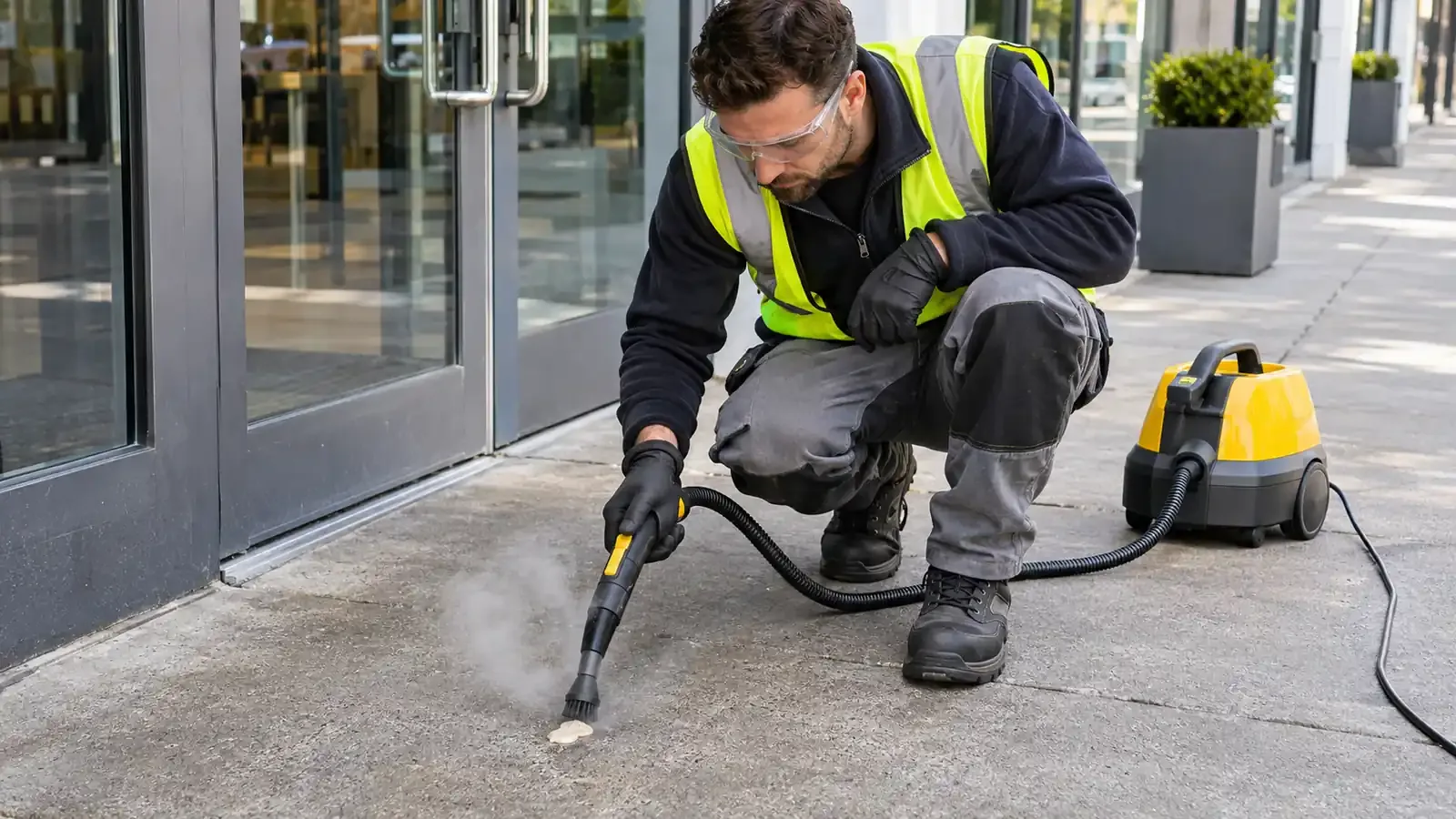
After a general wash, scattered gum spots may become more visible because the surrounding concrete is cleaner. The glass may be clear and the doorway orderly, yet flattened marks remain in the exact area where people slow down and look at the ground.
That mismatch is the real problem. Chewing gum removal from concrete should not be treated as one more item on a general pressure-washing checklist. It is a targeted finishing step, and the right scope depends on what remains visible across the customer’s approach to the door.
Why Routine Concrete Washing Can Leave Gum Behind
Old gum is not loose litter. Research on gum adhesion explains that it can be pressed against pavement by foot or vehicle traffic, spread across the surface texture, and harden as it ages. That helps explain why ordinary sweeping or a general cold-water cleaning pass may improve the surrounding concrete without fully releasing the gum.
This difference is why a sidewalk can look noticeably better after general cleaning while still needing a separate finishing pass at the entrance.
Concrete adds another complication. The Concrete Society notes that concrete is porous, so stains and cleaning solutions can enter its surface layers. A removed deposit may therefore leave a faint outline or a color difference. That does not automatically mean the gum is still present, but it does mean completion should be judged across the surrounding entrance, not one spot at a time.
Inspect the Entrance From the Customer’s Route
The most useful post-clean inspection follows the path people actually take. A close-up check can confirm whether a deposit was removed, but a wider view shows whether the entrance now reads as one maintained space.
Start at the normal approach line
Walk toward the entrance from the parking area, sidewalk, or main pedestrian route. Look for dark dots, pale outlines, or dense clusters that interrupt an otherwise even field of concrete. A spot that seems minor at arm’s length may be much more apparent when it repeats across the walkway.
Check where people pause
Pay extra attention near doors, outdoor seating, queue areas, benches, and waste receptacles. These are practical inspection points because people gather or wait there. The location of the deposits can matter as much as the total count.
Step back before accepting the work
Finish with a full-width view of the entrance apron. The question is not simply, “Was each piece detached?” It is, “Does the customer approach now look consistently clean?” That wider standard catches patchy results that a deposit-by-deposit check can miss.
Match the Cleaning Scope to the Pattern You See
There is no universal gum-count rule that decides the job. Use the visible pattern, the condition of the concrete, and how quickly new deposits appear to choose a proportionate response.
| What the Inspection Shows | Scope to Consider | Why It May Fit |
| One or two isolated deposits on otherwise even concrete | Targeted gum treatment | Limits work to the actual defect |
| Scattered old spots with visible outlines | Targeted treatment plus a controlled rinse or blending pass | Helps the treated spots sit more evenly within the surrounding area |
| Dense clusters near doors, seating, or bins | Broader entrance-zone cleaning | Treats the visible cluster as one field instead of unrelated dots |
| Gum plus widespread soil, traffic film, or uneven color | Full entrance or sidewalk cleaning | General surface condition, not gum alone, is affecting the finish |
| New deposits returning soon after prior removal | Recurring inspection and targeted removal | Keeps repeat locations from building into a larger restoration project |
These are planning categories, not technical instructions. Decorative concrete, pavers, joints, coatings, sealers, repairs, and worn areas may change which method is appropriate.
Steam Gum Removal Is a Method, Not a Universal Setting
Steam gum removal and other heated methods are used because warmth can help soften stubborn deposits. A current public-sector contract notice also specifies steam cleaning for gum on paved footways. That supports heat as a recognized approach, but it does not establish one safe temperature, pressure, chemical, or dwell time for every entrance.
The surface still controls the method. More pressure is not automatically more effective, and aggressive treatment can affect texture, color, joints, or an existing sealer. A careful gum removal service should account for the material, its condition, prior coatings, and a test area where uncertainty exists.
For property managers comparing options, our commercial gum removal service explains the difference between isolated treatment and a broader sidewalk scope. What matters is choosing the scope that will leave this particular entrance looking complete.
Plan the Work Around an Active Entrance
Sidewalk gum removal happens in a working pedestrian zone. The plan should cover more than the cleaning method: hoses, spray, wet concrete, access to the door, and drying time all affect how safely and smoothly the work fits around customers and tenants.
The UK’s Health and Safety Executive recommends cleaning during quiet periods, working in sections, and preserving a dry route when possible. Those are useful planning principles even though they are not Maryland law. Timing and access controls should reflect the actual site.
For an occupied property, that may mean treating one side of a wide entrance at a time or scheduling a narrow doorway before opening. The plan should preserve a usable route instead of asking customers to step around active equipment.
Washwater also deserves a site-specific plan. The Maryland Department of the Environment’s pavement and building washdown guidance distinguishes situations based on pollutants, cleaning products, solids control, and where the water goes. A storm drain should never be treated as the automatic destination for every commercial cleaning job.
Use a Repeatable Finish Standard
A simple acceptance check makes future service easier to scope and compare. Review the entrance after it has dried, then record the same four things each time:
- The normal customer approach and doorway are visually even.
- No dense gum cluster remains at a pause point.
- Treated areas do not create a more distracting patchwork than the original spots.
- Repeat locations are documented for the next inspection.
This turns commercial gum removal into a maintenance decision rather than a vague request to “get the sidewalk cleaner.” Isolated defects can receive isolated treatment. A patchy entrance can receive a wider blending or cleaning scope. A repeat hotspot can move onto a recurring inspection plan. The finish standard stays the same: the whole approach should look cared for when the work is done.
Frequently Asked Questions
Why can old gum remain after the sidewalk has been pressure washed?
General pressure washing is designed to clean the overall surface. Gum is a separate, bonded deposit that may have been flattened into the concrete and hardened over time. It often needs targeted heat, treatment, or agitation before the surrounding area is rinsed.
Can steam gum removal damage concrete?
Any cleaning method can cause problems when it is too aggressive for the surface. Sound uncoated concrete may tolerate a different approach than sealed, decorative, repaired, cracked, or weathered concrete. The operator should identify the surface condition and use the least aggressive effective method rather than assume one steam setting fits every slab.
Can a gum spot still be visible after the material is gone?
Yes. Old gum can leave an outline, discoloration, or a contrast between the treated spot and the surrounding concrete. A wider rinse or entrance-zone cleaning may improve uniformity, but complete color matching cannot be promised on every porous or weathered surface.
Should gum be removed before or after a full sidewalk cleaning?
When a full cleaning is planned, treating the gum first often makes sense so released residue can be included in the broader rinse and finish. The exact sequence should still account for the surface, cleaning products, pedestrian access, and washwater plan.
When is spot treatment enough?
Spot treatment may be enough when deposits are isolated, and the surrounding concrete already has a consistent appearance. If old marks are scattered across the whole approach or clustered near the door, a broader entrance-zone scope may produce a more even result.
How often should a commercial entrance be checked for gum?
Use recurrence rather than a universal calendar. A busy entrance with seating or a waste receptacle may need more frequent checks than a low-traffic walkway. Record where gum returns and how quickly the cluster becomes noticeable, then set the inspection interval from that pattern.
Can sidewalk gum removal be completed while a business stays open?
Often it can be planned around operations, but access must be managed. Quiet-hour scheduling, sectional work, a dry pedestrian route, and keeping people away from active spray and wet surfaces can reduce disruption. The plan depends on the doorway layout and traffic level.
Does gum removal prevent new deposits?
No. Removal corrects the current condition; it does not stop new litter. Waste-bin placement, routine inspections, and prompt treatment of repeat locations can help keep new deposits from building into a dense cluster.
