

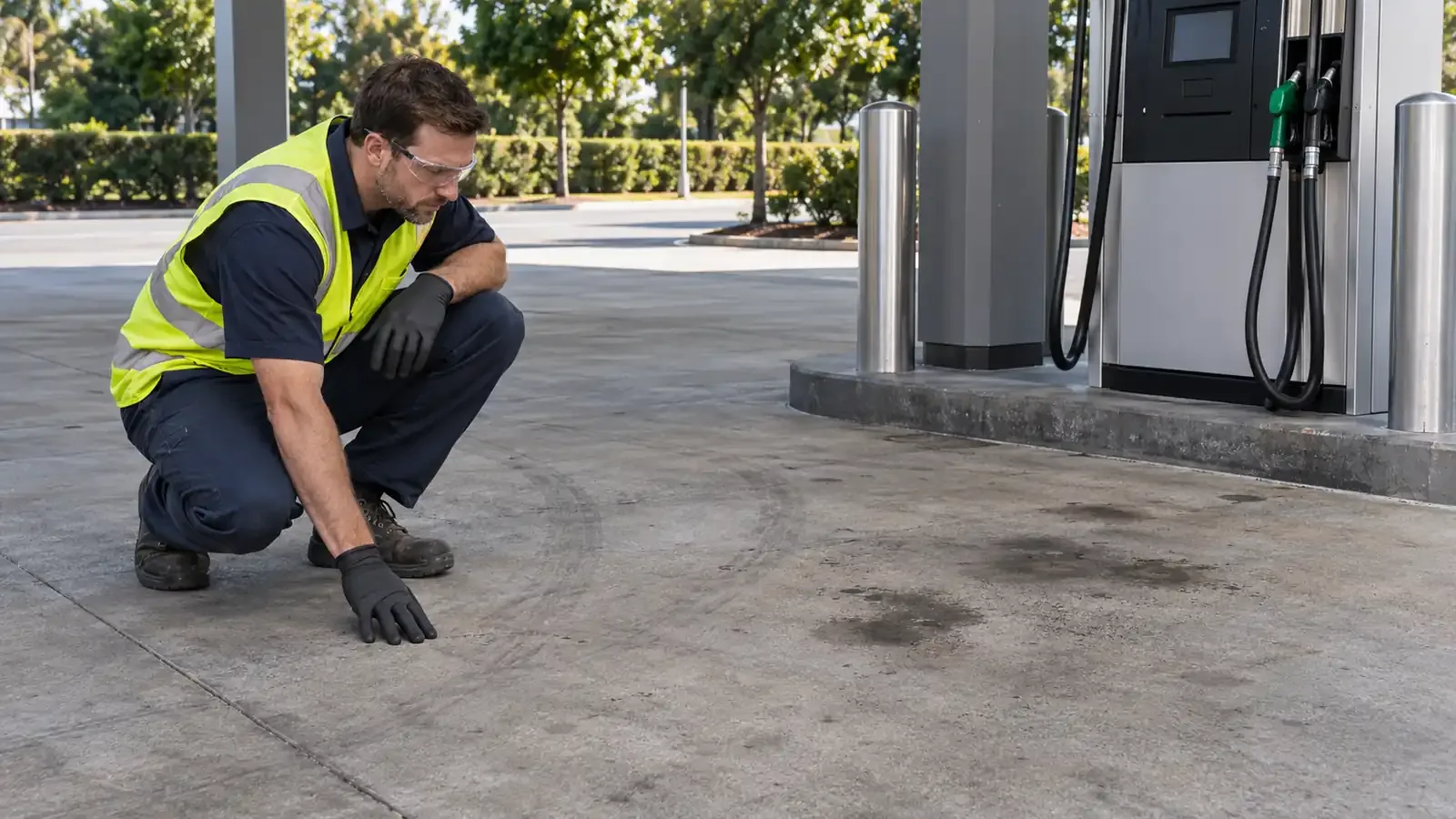
A pump island can look clean while the concrete is wet, then show dark halos and black marks again by afternoon. That does not automatically mean the cleaning failed. Old petroleum staining may remain inside the concrete, vehicles may deposit new residue immediately, or dirty washwater may have moved loosened material to another area.
Effective gas station pressure washing begins by identifying what returned. Fuel film, tire rubber, and road grime share the same concrete, but they require different treatment and maintenance decisions.
Why Pump Islands Re-Soil So Fast
Three kinds of contamination build up around fuel dispensers. Treating all three as ordinary dirt is why a powerful rinse can look impressive while wet and disappoint after drying.
Fuel Film Can Be New or Already Inside the Concrete
Fresh drips can leave a thin petroleum film on the surface within hours. Older fuel and oil behave differently because they can penetrate concrete rapidly, according to guidance from The Concrete Society.
Surface contamination may respond well to a compatible cleaning agent, sufficient contact time, agitation, and controlled washing. Deep discoloration may improve without disappearing completely. Gas station oil stain removal therefore needs its own expectations instead of being treated as ordinary concrete rinsing.
Tire Marks Are Transferred Material
Dark arcs near pumps, lane turns, and exit points often come from rubber and other tire compounds transferring onto the concrete. Braking, acceleration, and sharp turns increase that transfer.
These marks are not necessarily leftover dirt. A general surface pass may clean the surrounding concrete while leaving the rubber deposit visible, making the mark appear even darker by contrast.
Road Grime Starts Returning Immediately
Vehicles continuously bring in fine dirt, grit, moisture, and residue from surrounding roads. Approach lanes and turning areas can begin collecting new material as soon as traffic resumes.
The pump islands, forecourt, store entrance, and canopy also soil at different rates. Gas station canopy cleaning may address dust and film on the underside, fascia, and columns, but it should not determine how often the concrete below receives attention.
Read the Pattern After the Concrete Dries
The return pattern offers useful clues, although it does not confirm the cause by itself. Inspecting the site after the slab dries provides a more useful baseline than judging reflective, uniformly dark wet concrete.
| What appears after cleaning | What it may indicate | What to check next |
| The same dark halo in the same place | Absorbed petroleum staining or remaining residue | Compare dry before-and-after photos and set realistic restoration expectations |
| New curved black lines | Fresh tire transfer | Map braking, turning, and acceleration points |
| A gray film across approach lanes | Newly deposited road soil | Review sweeping and high-traffic maintenance frequency |
| Dirty streaks following drainage or rinse paths | Loosened material may have moved or settled again | Review the rinse direction and washwater recovery plan |
| A new wet patch or active drip | Fresh contamination, not an old stain returning | Use the station’s spill-response procedure and investigate the source |
Tire-mark cleaning guidance for industrial concrete similarly recommends considering the concrete finish, residue severity, cleaning-agent compatibility, and need for repeated treatment instead of simply increasing cleaning force.
A Lasting Clean Starts Before the Pressure Washer
Gas station concrete cleaning is a sequence, not a single high-pressure pass. Each stage keeps one kind of contamination from undermining the next.
- Address active spills and loose material first. Sweep grit and use the site’s approved dry-cleanup procedure for fresh petroleum. The EPA’s fueling-facility guidance recommends dry cleanup before washing and collection of the resulting washwater.
- Divide the property into cleaning zones. Pump pads, turning lanes, curbs, bollards, store entrances, and canopy surfaces have different materials and contamination levels.
- Match treatment to the soil. Petroleum film, tire residue, gum, and mineral road dirt do not respond identically. The surface finish, coating, stain age, and condition also affect the appropriate method.
- Move loosened contamination without spreading it. Uniform flatwork cleaning, edge detailing, and controlled rinsing matter because oily water can settle on adjacent concrete. Concrete Institute guidance specifically warns against letting soiled water redeposit oil after it has been loosened.
- Recover and inspect. The job should end with managed washwater, cleared edges and drains, and another inspection after the concrete has dried.
In Maryland, MDE pavement and building washdown guidance makes the disposal path depend on factors such as oil or grease contact and chemical use. Possible routes can include collection and off-site disposal, an approved sanitary-sewer discharge, or another permitted option. The property’s drainage and applicable local requirements must be evaluated before work begins.
Clean Each Zone on Its Own Clock
A station-wide calendar can leave pump islands under-serviced while cleaning slower-soiling surfaces unnecessarily. The better schedule follows what happens in each zone.
| Zone | Routine attention | Periodic service focus |
| Pump islands | Spill response, sweeping, and visual checks | Petroleum film, tire residue, curbs, and dispenser-base areas |
| Turning and approach lanes | Debris removal and new-mark monitoring | Broader forecourt and concrete cleaning |
| Store entrance and walkways | Litter, gum, and tracked-soil checks | Detailed surface cleaning based on traffic |
| Canopy and columns | Condition and cleanliness inspection | Underside, fascia, columns, and suitable exterior surfaces |
| Trash and dumpster areas | Leak and debris control | Separate grease, residue, and pad-cleaning scope |
Gas station cleaning services should use the first completed cleaning as a baseline. Inspect the fully dry property, document where contamination returns first, and adjust each zone’s frequency from those observations. A high-traffic pump pad and a canopy fascia do not need to share the same interval.
Our gas station cleaning service separates pump-island and canopy cleaning, full-forecourt cleaning, and complete-property cleaning into distinct scopes. Before requesting a quote, identify the fastest-soiling zones and ask how contaminant type, dry cleanup, washwater handling, sensitive equipment, and dry-down inspection will be addressed.
Judge the Result After the Concrete Dries
The real test is not how bright the wet slab looks when the equipment is packed away. It is what remains after drying and what appears again once traffic resumes.
A returning mark in the exact outline of an old stain calls for a different response than fresh tire arcs or a new layer of road grit. When the cleaning plan separates embedded discoloration from new contamination, operators can choose targeted restoration, routine housekeeping, or a shorter service interval instead of repeatedly applying more pressure to the entire property.
Frequently Asked Questions
Why can pump islands look dirty again only hours after cleaning?
Wet concrete can temporarily reduce visible contrast. As it dries, old absorbed stains may become easier to see. New fuel drips, tire transfer, and road soil can also begin accumulating as soon as vehicles return.
Can pressure alone remove fuel film from concrete?
Not reliably in every case. Loose dirt may rinse away, while petroleum residue can require a compatible pretreatment, sufficient contact time, agitation, and controlled rinsing. The concrete’s condition and the depth of the stain affect the result.
Can old oil stains be removed completely?
Some stains can improve substantially, but complete removal cannot be promised. Fuel and lubricating oil can penetrate concrete, and deeply absorbed discoloration may require repeated treatment or remain partly visible.
How often should pump islands be professionally cleaned?
There is no universal interval. Track how quickly unacceptable buildup returns after a documented baseline cleaning. Traffic, fresh spills, vehicle turning patterns, surface condition, and routine housekeeping should determine the schedule.
Is gas station concrete cleaning the same as cleaning an ordinary parking lot?
No. Fuel-adjacent concrete can contain petroleum residue and may require dry cleanup, contaminant-specific treatment, and stricter washwater planning. Pump islands also contain sensitive equipment and concentrated vehicle traffic.
What should gas station canopy cleaning include?
The scope may include the underside, fascia, structural columns, painted islands, and other suitable surfaces. Materials, coatings, signage, lighting, dispenser equipment, and access conditions should be reviewed before the method is selected.
What happens to washwater from a gas station cleaning?
That depends on the contaminants, cleaning products, drainage system, and applicable requirements. Petroleum-contaminated or chemically affected water should not simply be directed into a storm drain. The disposal route must be planned for the individual site.
