

Rain can rinse loose dust from a parking lot and make the pavement look darker for a few hours. Once the surface dries, though, white tracks, dark parking-space spots, black turning marks, and dirty curb lines often return. That is the point when more weather is unlikely to provide a useful answer.
Parking lot pressure washing can target what winter traffic leaves behind, but only after the remaining marks are sorted by type. Deicer residue, oil, rubber, organic growth, and damaged pavement do not call for the same response.
For a property manager, the practical question is not simply, “Will this wash off?” It is, “Is this removable buildup, a stain that may only improve, or a surface problem that cleaning cannot fix?”
Why Rain Is Not a Parking Lot Cleaning Plan
Rain is an uncontrolled rinse. It can move loose grit, but it provides no stain treatment, agitation, even coverage, or plan for contaminated water. It may also carry oil, sediment, and other material toward drains rather than remove them from the property.
This matters after winter because vehicle traffic can repeatedly deposit material in the same places. Tires can carry deicer and road film into entrances, ramps, turns, and parking stalls. Vehicles can add oil and other fluids. Plowing and foot traffic can push grit against curbs and islands. A wet lot can hide the pattern; a dry lot reveals what remains bonded to, absorbed into, or damaged within the surface.
Use the first dry period after rain for a walk-through. Photograph the same areas wet and dry, especially entrances, accessible routes, ramp turns, drains, loading areas, and long-term parking spaces. The contrast helps separate loose dirt from persistent staining and shows where a targeted cleaning scope may be more useful than washing the entire lot uniformly.
Read the Mark Before Choosing the Cleaning Method
Color alone cannot confirm a cause, but location, texture, and what happens after drying can narrow the next step. Unknown fluids should be treated cautiously rather than identified by appearance alone.
White residue that returns after the pavement dries
Chalky tracks near entrances, ramps, and vehicle drip lines may be deicer residue carried in by traffic. A small test area can show whether the mark dissolves and rinses away. White material that returns near cracks, joints, or damp areas may instead be mineral deposits carried to the surface by moisture. Repeated cleaning will not correct the water path behind that pattern.
Federal Highway Administration guidance on deicer-related concrete distress describes scaling, crazing, and deterioration as pavement distress rather than surface dirt. If the concrete is flaking, pitted, or breaking apart, document it for repair evaluation before using aggressive cleaning as the next step.
Dark spots, black arcs, and dirty traffic lanes
Dark spots that still look wet on a dry day often point to oil or another vehicle fluid. Fresh spills call for dry absorbent cleanup before washing. Older oil can soak into porous concrete, so stain-specific pretreatment and controlled washing may improve it without making complete removal a realistic promise.
Black arcs at turns and ramps are more likely to be rubber transfer and traffic film. Long gray lanes can be a mixture of fine grit, road film, and repeated tire contact. These patterns may respond to targeted treatment, but the method still needs to match concrete, asphalt, pavers, a coated parking deck, and any nearby painted markings.
Marks that cleaning should not be expected to repair
Cracks, loose aggregate, potholes, peeling coatings, exposed metal, rust bleeding from concrete, and standing-water patterns are maintenance or repair signals. Cleaning may reveal their boundaries more clearly, but it cannot restore missing pavement, stop a leak, correct drainage, or replace a failed coating.
That distinction protects the maintenance plan from becoming a cycle of stronger chemicals or higher pressure on a surface that needs a different trade. It also gives property managers a cleaner baseline for discussing repairs, striping, drainage, or coating work.
What a Targeted Post-Winter Cleaning Scope Should Include
A useful scope begins with the lot’s actual conditions, not a one-size-fits-all wash. The sequence usually matters more than raw pressure:
- Remove loose material first. Sweep grit, salt crystals, litter, and curb-line debris. Use dry absorbent methods on fresh oil or grease.
- Map surfaces and sensitive areas. Identify concrete, asphalt, pavers, deck coatings, joints, striping, drains, door thresholds, and areas already showing damage.
- Group stains by treatment need. General traffic film, oil spots, rubber marks, organic buildup, and white residue may require different preparation or may need to be excluded pending inspection.
- Test a small area. Confirm that the treatment improves the stain without lifting paint, opening a coating, or marking the pavement.
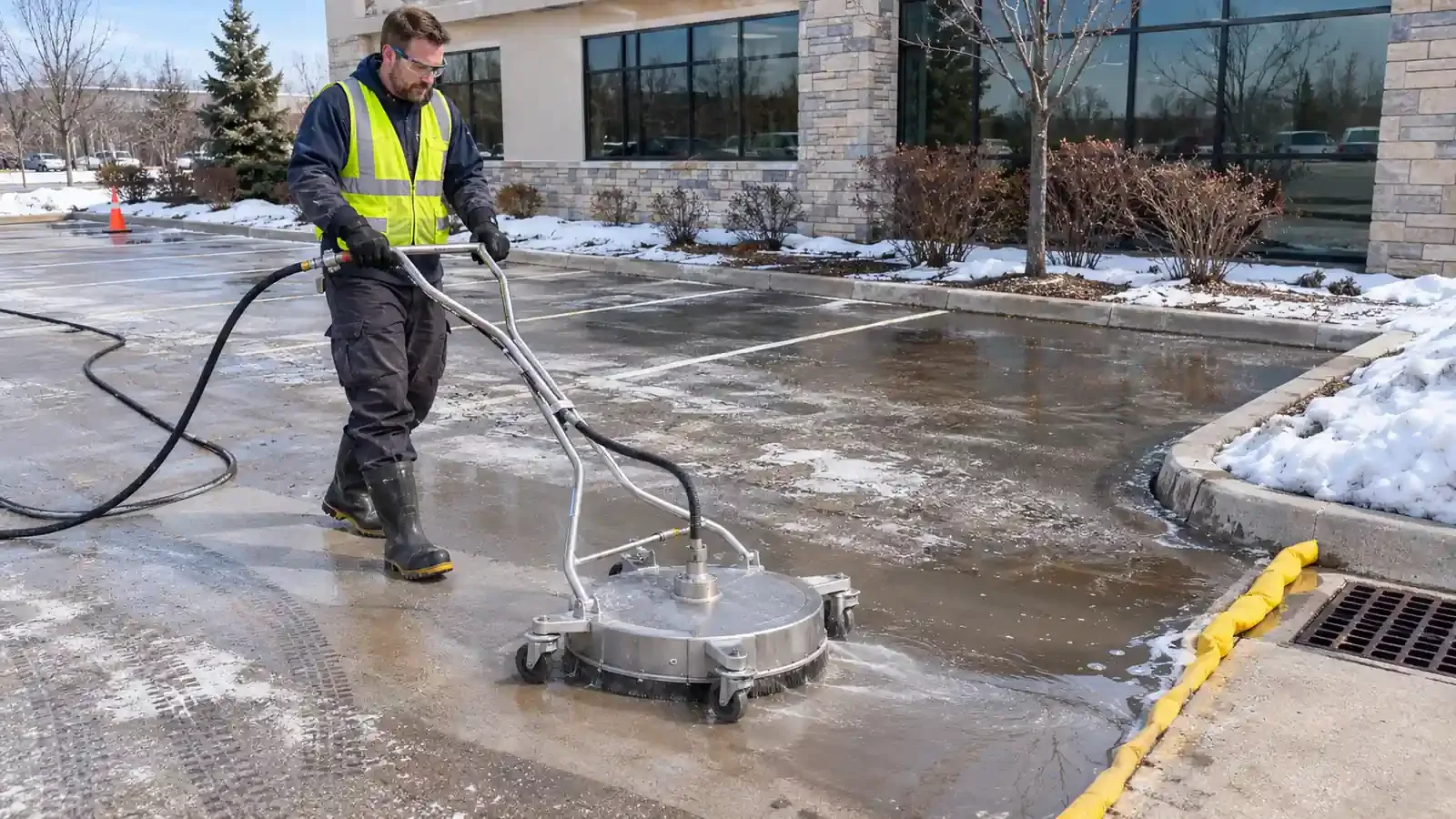
- Control the work zone and water. Plan vehicle and pedestrian access, protect drains as required, and decide how washwater will be filtered, collected, directed, or disposed of.
- Judge the dry result. A wet surface can look uniformly clean. Review it again after drying to identify stain shadows, missed edges, damage, or areas that belong in a repair scope.
For Maryland properties, washwater planning is part of the job rather than an afterthought. The Maryland Department of the Environment’s pavement and building washdown guidance calls for dry cleanup of oil and grease deposits and control measures for mobilized solids and other pollutants. The correct handling still depends on what is on the pavement, whether cleaners are used, where the water would go, and the applicable local requirements.
Set Expectations Around Improvement, Not Erasure
The best post-winter result is not always a pavement surface that looks new. It is a controlled improvement with clear expectations for every stain category.
Loose grit and general film may clean evenly. Fresh oil may respond better than a dark spot that has soaked into concrete for years. Deicer residue may disappear, while actual scaling remains visible.
Asphalt, painted lines, sealers, and parking-deck membranes may require gentler or manufacturer-specific methods. A successful cleaning can also expose faded striping, cracks, or coating wear that were previously hidden by grime.
Before approving a proposal, ask the contractor to identify the surface types, stain groups, test area, drain locations, washwater plan, access plan, and expected limits. Those answers are more useful than a blanket promise based on pressure alone.
Use the Dry Lot as the Decision Point
When rain stops changing the appearance and the same marks keep returning, the lot has given you a workable maintenance map. Clean the bonded buildup that can be treated, set realistic expectations for absorbed stains, and route cracking, flaking, drainage, or coating failures to the appropriate repair professional.
For a site-specific scope, our parking lot and garage cleaning service can help you review the parking surface, stain concentrations, drains, access needs, and realistic cleaning outcomes before work is scheduled.
Frequently Asked Questions
Does rain remove road salt from a parking lot?
Rain can dissolve and move some deicer residue, but that is not the same as controlled removal. Residue can collect along curbs, joints, low areas, and drain paths or become visible again after the pavement dries. Sweep loose material first, then evaluate remaining white marks in a test area.
Can parking lot pressure washing completely remove old oil stains?
Not always. Fresh oil on the surface is generally a better cleaning candidate than contamination that has soaked into porous concrete over months or years. Pretreatment and controlled washing may substantially improve an old stain, but a permanent shadow can remain.
Should a parking lot be swept or pressure washed after winter?
These methods solve different problems. Sweeping removes loose grit, litter, sand, and salt crystals. Pressure washing targets bonded film and stains after loose material and fresh spills have been handled. Many lots benefit from sweeping first and then washing only the areas that need it.
Can asphalt and concrete be cleaned the same way?
No. Asphalt, poured concrete, pavers, coated decks, sealers, and painted markings can tolerate different cleaners, temperatures, and pressure. The scope should identify each surface and include a small compatibility test before broad cleaning begins.
Will pressure washing damage parking lot striping?
It can if the paint is already peeling, the treatment is too aggressive, or the spray is concentrated at an edge. Existing line condition should be documented before cleaning. A test area helps show whether the markings can remain or whether restriping should be planned after the surface dries.
What does it mean if a white stain keeps coming back?
The mark may not be leftover road salt. Moisture can carry minerals through concrete and leave a white deposit at the surface, especially near cracks, joints, walls, or recurring damp areas. If the pattern returns after cleaning, investigate the moisture source or pavement condition instead of repeating the same wash.
Can parking lot washwater go into a storm drain?
Do not assume it can. Oil, grease, sediment, cleaners, and the drainage destination can change what controls are needed. Maryland guidance calls for dry cleanup of oil and grease and measures to control pollutants; the property’s local stormwater or sanitary authority may have additional requirements.
